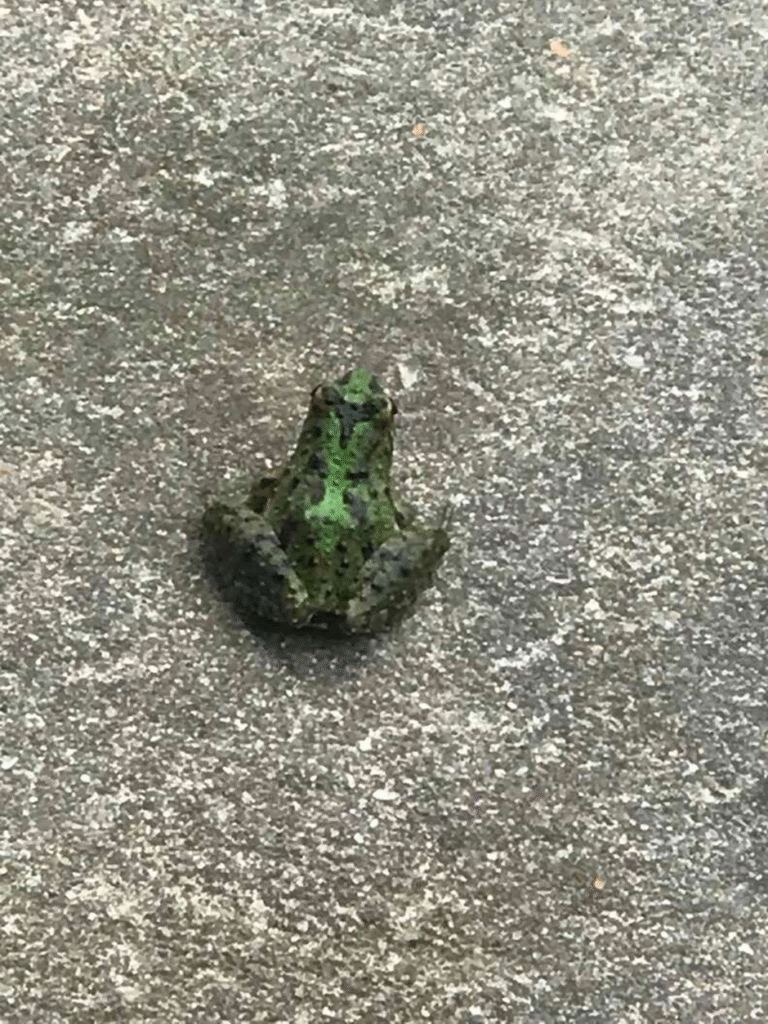

Professor Alistair Thorne, PhD, had spent thirty years mapping the ecological anomalies of the Amazon basin. His current mission, however, was in his own backyard, or rather, the muddy, rock-strewn creek bed just behind his research cabin. He was hunting for the elusive Microhyla pulchra, a tiny frog known locally as the “Moss Pebble.”
Alistair was hosting two bright-eyed graduate students, Clara and Ben, and the search had turned into a lesson in humility. The creek flowed over a bed of smooth, rounded river stones, slick with shallow water and algae. The light was dappled, the air humid, and the entire surface was a dizzying mosaic of browns, deep ochres, and wet greys.
“Look at the data, not the surface,” Alistair instructed, kneeling gingerly on the wet bank. “Its body temperature must match the rock it’s resting on, and its color pattern is genetically programmed for this exact riverbed. It’s not hiding; it’s simply being the environment.”
Ben and Clara exchanged a doubtful look. They were staring at a patch of creek no bigger than a dinner plate—a tangle of small, waterlogged clover leaves and slick stones, all partially submerged in slow-moving water.
“But Professor,” Clara said, squinting, “it’s supposed to be bright green, isn’t it? A moss frog?”
“It has to be,” Alistair replied with a slight smile. “But nature’s green is rarely just one color.”
The Perfect Deception
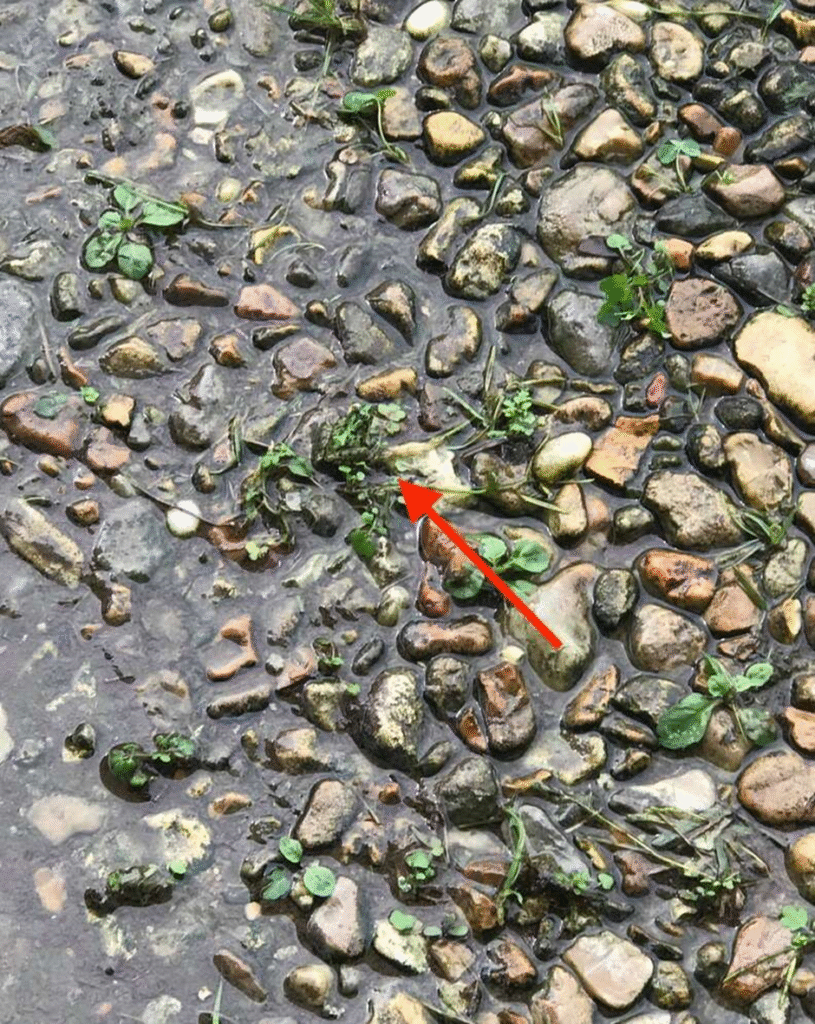
The subject of their discussion was right there, anchored firmly in the matrix of pebbles and small, brown debris: Ferdinand.
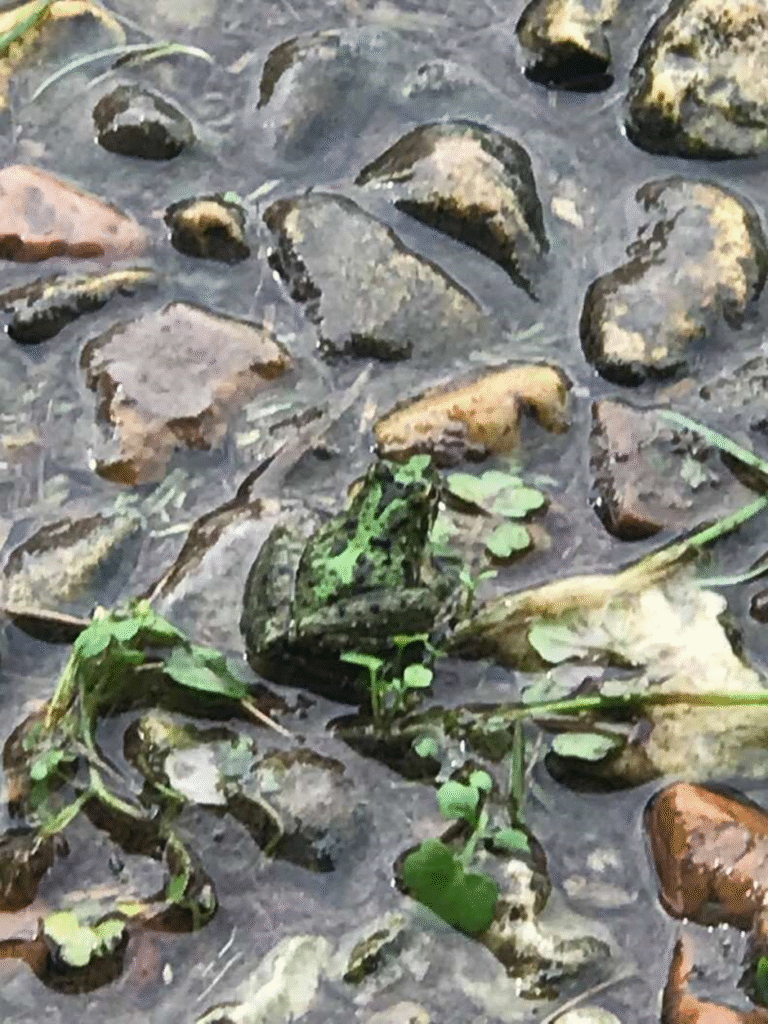
Ferdinand wasn’t merely green; his skin was a topographical map of his surroundings. His body, squat and muscular, was the dull, charcoal grey of a water-worn pebble, providing the base camouflage. But stitched across his back, running from the ridge of his spine to the tops of his legs, were intricate, random-looking splatters of electric lime and deep emerald green.
These green patches weren’t random at all. They mimicked the few, vibrant blades of grass and bright clover sprouts that had managed to root themselves between the stones. One patch of green on his left shoulder was perfectly shaped like a leaf that had fallen and gotten wedged against a nearby rock. His eyes, tiny and dark, were positioned high on his head, just visible above the water level, allowing him to watch the world without moving a single muscle.
He was the ultimate optical illusion. A predator, scanning the rocks for the uniform shape of a frog, would see only broken patterns—a collection of stones, water, and bits of plant matter. His stillness was absolute, his camouflage an armor.
The Moment of Discovery
Ben, growing frustrated, lifted a small, muddy stick and started lightly poking at the stones. “I’m telling you, it’s not here. Maybe the ultrasonic sensor was wrong, or maybe it moved after the rain—”
Before he could finish, Alistair placed a hand on his shoulder. “Patience, Benjamin. Camouflage works best when you’re moving fast, looking for a target. It fails when you slow down and start appreciating the texture.”
He pointed a thick finger at the waterlogged patch, near a sliver of white, glistening stone (Image 1, where the arrow indicates a slight disturbance). “Look at the dark spot next to the clump of clover. It’s too symmetrical for a pebble. A stone has random curves. That dark shape has two tiny, raised nodes—the eyes.”
Clara leaned in, pressing her face close to the muddy water, ignoring the discomfort. The focus of the hunt narrowed until her entire world was that small, wet patch. The rocks suddenly ceased to be random and started to feel like a carefully constructed pattern.
Then, she saw it. The dark base color, the shocking greens, the perfect alignment with the wet debris. Ferdinand, the Moss Pebble, was staring right back at her. He was smaller than her thumbnail, yet his power over the visible world was absolute.
“I… I see him,” Clara breathed, pulling back slowly, a thrill of scientific wonder overriding her frustration. “He’s beautiful.”
Just as Ben and Alistair leaned in for confirmation, the illusion broke. Having been discovered, Ferdinand chose retreat. In a blur of brown and green, he launched himself off the stone, a tiny ripple disturbing the still water, and disappeared instantly into a thicker tangle of roots and shade.
The students looked at the empty spot where the tiny frog had been. The stones looked like ordinary stones again.
“And that,” Alistair said, straightening up with a satisfied sigh, “is why no one can spot the little frog. Because when you finally see him, he’s already gone.”