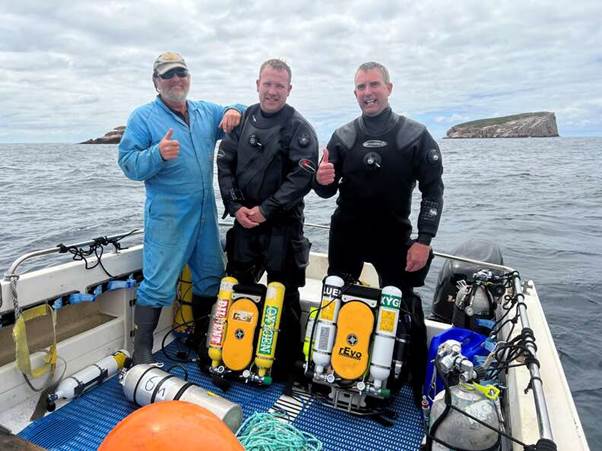
The SS Tipton, a cargo freighter sunk by a German U-boat in 1943, was not a secret. It rested 150 feet beneath the choppy, cold surface of the North Atlantic, a colossal iron tomb slowly being consumed by the relentless ocean. For the wreck diving team led by Dr. Anya Sharma, the Tipton was a historical site, a three-dimensional artifact of wartime sacrifice, covered in seventy years of soft coral, barnacles, and rusticles.
On this particular expedition, the mission was not salvage, but documentation. We were mapping the long-term ecological impact of the wreck—how this massive, metallic intrusion had evolved into a complex artificial reef. The dive plan called for entering the remains of the midship mess hall, an area now pitch black and structurally compromised, but historically fascinating.
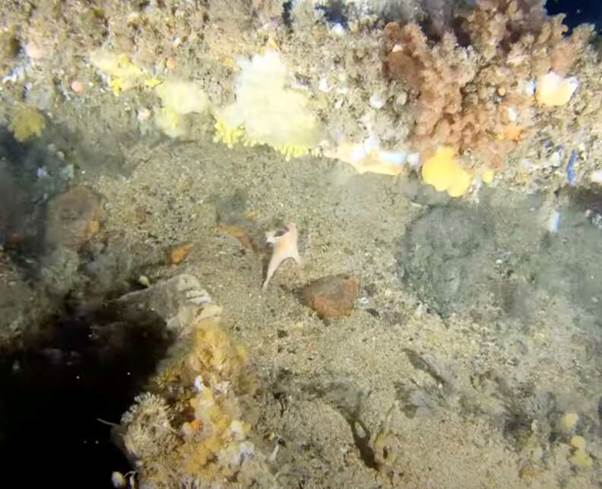
The first 15 minutes of the dive were routine. The two-person team, Anya and her dive partner, Leo, moved slowly through the wreck, their powerful lights cutting through the particulate-heavy gloom. The sight was the usual blend of melancholy and majesty: school of silver fish darting through broken portholes, massive Atlantic cod lurking in the shadows of twisted steel beams, and the deep, haunting silence broken only by the sound of their own exhaled bubbles.
Anya signaled Leo to follow her into the mess hall. The entry was tight, requiring them to momentarily turn their tanks sideways to squeeze through a jagged break in the hull plating. Once inside, the world narrowed. The chamber was small, roughly the size of a shipping container, tilted on its side and utterly dominated by a large, shattered wooden table that had long ago become fixed to the ceiling by calcification.
They were working against the clock. At this depth, bottom time was severely limited. Anya moved her light beam slowly, sweeping it across the debris-strewn floor, looking for any identifiable artifacts—a fallen plate, a boot, anything to ground the history.
The beam stopped abruptly near a cluster of brilliantly colored encrusting sponges—yellows and fiery oranges that seemed impossibly vibrant in the deep blue.
“Did you see that?” Anya’s voice crackled slightly over the comms system.
“See what? Just some amazing sponge growth,” Leo replied, his tone pragmatic.
“No. Look closer, near the orange plate. It moved.”
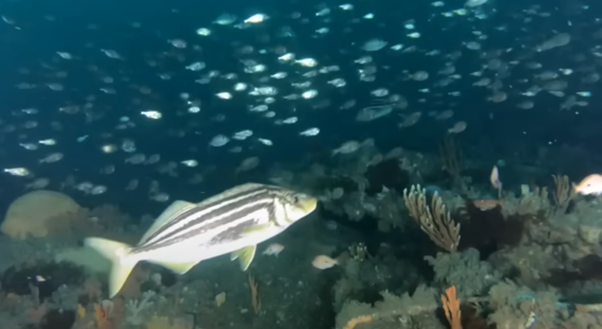
Anya adjusted her position, shining her light directly into a dark crevice formed by a partially collapsed steel locker. She knew what she was looking for wasn’t a fish native to the region, and yet… there it was.
Hiding, tucked securely within the safety of the wreck’s infrastructure, was a fish whose existence in this particular region was not only unlikely, but practically impossible.
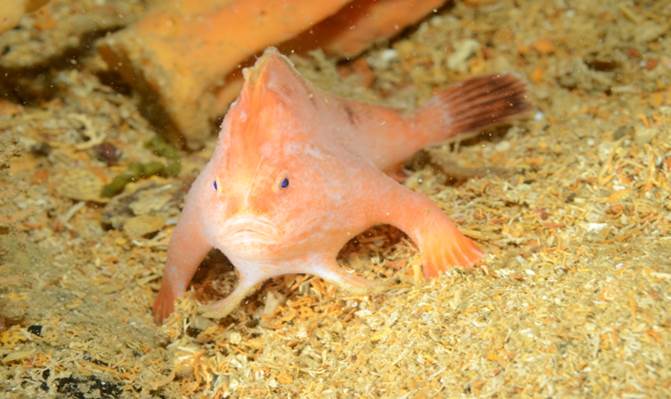
It was a Pygmy Angelfish (Centropyge interrupta).
In the blackness, this creature was a living, breathing jewel. It was small, no larger than Anya’s thumb, and its body radiated an intense electric blue that seemed to glow independently of the divers’ lights. Its fins were trimmed with brilliant neon yellow, and its head was capped by a startling, vertical stripe of crimson. It was utterly breathtaking—a splash of the vibrant, shallow, sunlit tropical Pacific, found 150 feet deep inside a corroding Atlantic freighter. .
“Leo, do you see the markings? That’s a Centropyge interrupta,” Anya breathed, her voice filled with a mixture of disbelief and reverence.
Leo slowly swam closer, positioning his camera rig. “Impossible. That species is listed as critically rare and endemic only to deep reefs off the coast of Japan and Hawaii. We are hundreds, thousands of miles out of its known range.”
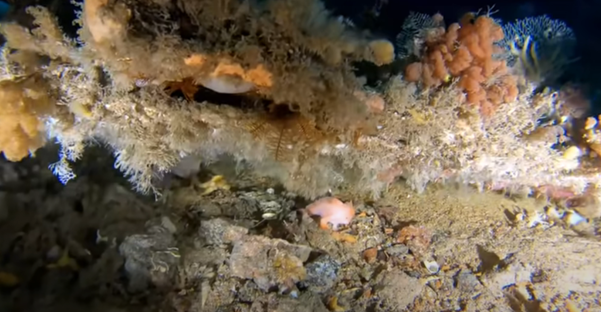
Yet, there it was, calmly observing them, occasionally nibbling at the algae growing on the sponge. It was a single specimen, an outlier, a complete anomaly. It didn’t look sick or disoriented; it looked perfectly at home, having made the shattered remains of a World War II ship its own personal, highly protected reef structure.
The initial surprise quickly shifted into scientific urgency. This wasn’t just a lost fish; it was evidence of an unprecedented dispersal event and the remarkable ecological role sunken ships play in marine life conservation. How did it get there?
The most plausible theory, which Anya quickly began recording for her report, was that the fish had somehow hitched a ride. Perhaps as a tiny larva, it had been swept up in a rare, warm-water current, or, more likely, it had been transported accidentally via a long-distance research vessel or a trans-oceanic cargo ship that traveled between the Pacific and the Atlantic.
Regardless of the journey, the Tipton provided the perfect sanctuary. The wreck, with its multitude of nooks, crannies, and overhangs, offered the highly vulnerable Pygmy Angelfish protection from larger Atlantic predators. The enclosed mess hall, constantly being filtered by nutrient-rich cold water currents, had allowed a stable micro-environment to develop, providing ample food (algae and small invertebrates) and, critically, security.
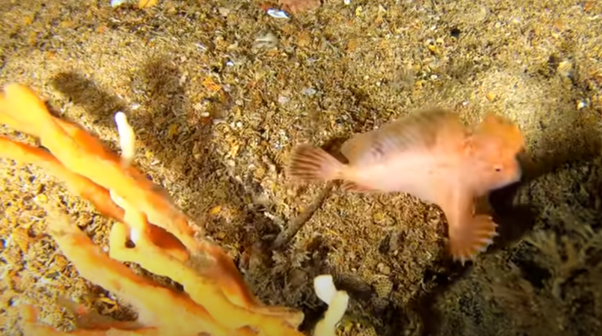
The finding wasn’t just exciting; it underscored a crucial point in marine biology: that man-made structures, even those born of destruction, can become essential habitats and stepping stones for marine species, particularly those struggling against shrinking natural reef systems. The little Angelfish, thriving in the belly of a sunken battleship, was proof of nature’s powerful ability to reclaim and repurpose.
Anya and Leo spent the remaining minutes filming, documenting the size, color, and behavior of the Pygmy Angelfish. They named him “Whiskey,” a nod to the ship’s cargo manifest and the unlikely place he now called home.

As they began their long, multi-stage ascent back to the surface, the image of Whiskey—the electric blue splash of life in the silent, dark steel hull—was burned into their memory. The Tipton was no longer just a history marker; it was a beacon, protecting one of the ocean’s rarest secrets, proving that life, in its most beautiful and tenacious forms, will always find a way to bloom, even in the most shadowed and unexpected corners of the world.